
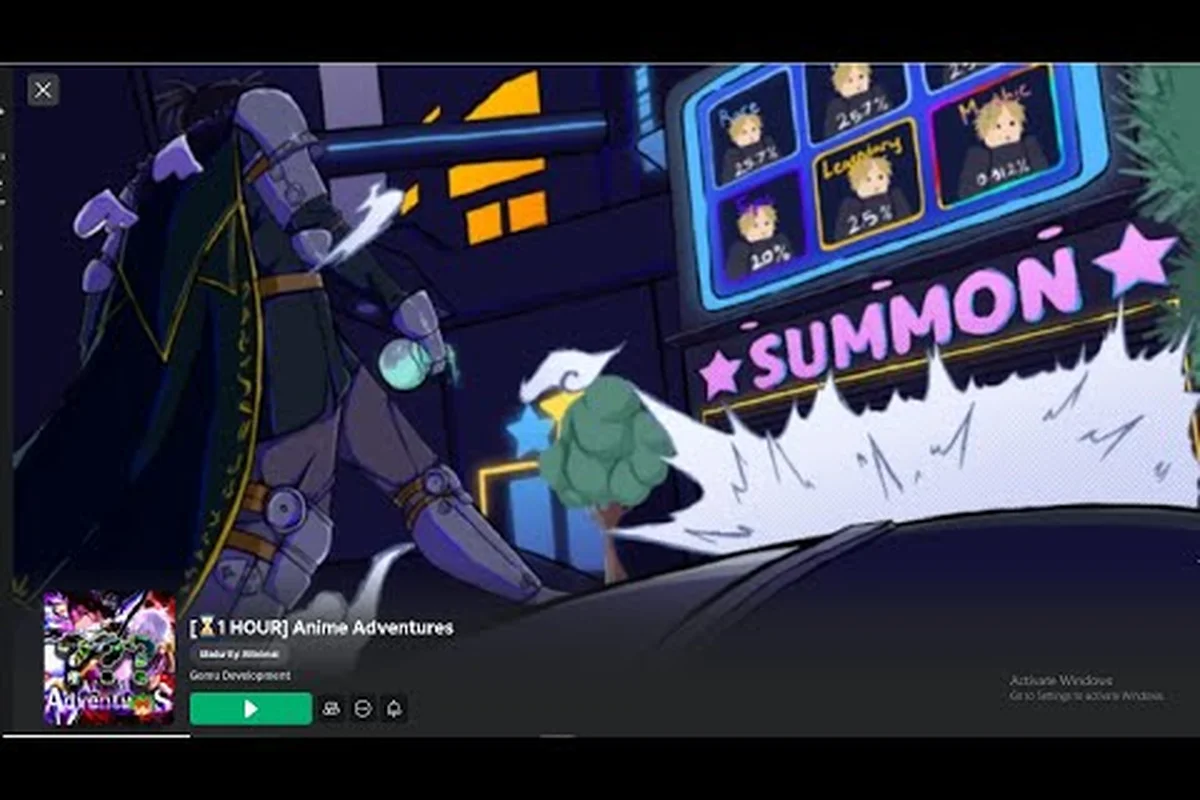
Anime Adventures upgrade guide priorities matter because better decisions early preserve gems, improve squad planning, and make wave defense more consistent. Learn which upgrades to prioritize, when to focus, and what to check during your first week without relying on unverified stats.
The official Anime Adventures game page describes a Roblox strategy and tower-defense game by Gomu Development. Players summon anime characters, level units to unlock abilities, build a squad, and defend against incoming waves. The page shows strong community interest, including 323,483 visits, 1,832 favorites, and a 30-player server cap during the October 2026 research pass.
Anime Adventures Upgrade Guide: Strengthen the Units You Own
A practical anime adventures upgrade guide starts with the progression systems confirmed by official information and player experience. The essential sequence is straightforward: summon a roster, choose one dependable main damage unit, learn the opening waves, improve the unit carrying your runs, and then add deeper modes such as dungeons, raids, relics, and Limit Break.
That order matters because spreading attention across every available system can leave your main team unprepared. A focused setup creates more consistent results from each wave, and it also makes it easier to understand which changes are helping. Use the Anime Adventures new player guide when you need a broader look at the opening steps, but keep the central rule simple: build around a unit that you understand and can place reliably.
| Upgrade decision | Recommended starting action | Reason |
|---|---|---|
| Team construction | Build around one main damage unit first | Concentrates progression and simplifies placement learning |
| Unit levels | Prioritize the unit used in repeated runs | Improves the part of your squad you can rely on most |
| Summoning | Add variety after establishing a core | A broader roster is less useful without a dependable lead unit |
| Gems | Save them until you have a clear spending goal | Prevents early consumption without a defined purpose |
| Evolutions and relics | Add them after basic wave defense works | These systems become more useful after the core squad is stable |
Separate Upgrades From Additions
An upgrade improves something you already own, while an addition expands what you own. A new character is an addition; leveling a character, unlocking another ability, or progressing that character through community-documented systems is an upgrade. Treating those ideas as interchangeable can create a frustrating shopping list with no clear order.
The official game page confirms that leveling units unlocks abilities, but it does not publish level caps, stat breakpoints, summon rates, or exact upgrade costs. Avoid planning around fabricated numbers. Instead, compare the unit you use most with the resources available to you, then ask whether that change improves the role your squad is missing.
This distinction also prevents a common early mistake: treating every new summon as an upgrade. More characters can create coverage, but they do not automatically improve your defense if your main damage unit remains under-leveled or poorly placed. Community guides mention Evolution, Starfruit, Relic, and Limit Break, but these should be treated as progression layers rather than guaranteed early wins.
Establish the Core Squad
Your core squad should have a clear purpose. The official premise centers on summoning heroes and defending multiple worlds, while the gameplay description emphasizes leading a team of anime units. A practical first squad therefore needs reliable damage, enough coverage to handle the opening story waves, and a clear deployment pattern that you can repeat.
Only Rukia and Fusion Vegeto have verifiable community mentions in the reviewed material, so do not assume a wider named roster is confirmed. More importantly, do not build a tier list around invented character names or placements. Choose a character you already own, observe how the unit behaves, and use that result to guide your next decision.
The Anime Adventures progression checklist can help you track broader milestones, but your squad plan should remain small. If a new summon cannot explain how it helps the current core, leave it aside while you improve the team already carrying your progress.
Anime Adventures Wave Defense Guide: Turn Placement Into Progress
A useful anime adventures wave defense guide focuses on placement, timing, and repeatable decisions. Beginner videos frame the first session around learning those fundamentals rather than spending every gem immediately. The goal is not to maximize one spectacular setup; it is to establish a formation that survives enough waves to earn progress consistently.
| Defense question | What to observe | Practical response |
|---|---|---|
| Can my main unit attack useful targets? | Whether the unit contributes before enemies reach the objective | Adjust placement to create clearer attack paths |
| Are multiple units contributing? | Whether damage comes from one unit or the whole team | Upgrade the neglected role after correcting coverage |
| Is the formation understandable? | Whether you can explain why each unit is placed there | Keep a simple arrangement you can reproduce |
| Does the squad survive consistently? | Whether similar waves produce similar outcomes | Fix formation before chasing a new upgrade |
Learn the Opening Waves
Opening story waves are the right training ground because they let you learn the game’s tower-defense rhythm without the complexity of every endgame system. Watch how enemies approach, where your units can attack, and which positions remain idle. Because no verified wave schedule or enemy data was available, rely on what you see during play rather than on community formulas that may not match the current version.
The Anime Adventures World Enemies overview is useful for organizing the questions you should ask while defending, but the official page does not provide enough data to reproduce a fixed map solution. Record your own results. A short note about formation, difficulty, and outcome is more dependable than a universal placement claim that may not fit your squad.
Start with a small change at a time. Move one unit, watch the next wave, and compare the result. If the same arrangement fails repeatedly, identify the uncovered role before upgrading anything. A newly upgraded unit placed in the wrong position may not produce a meaningful improvement, which is why placement should be tested alongside upgrade choices.
Protect the Main Damage Role
Main damage should receive early attention, but “main damage” does not mean every resource goes into one unit without limits. The unit needs a stable role, and the squad needs enough support to make that role sustainable. Since the game’s published material does not provide damage numbers or role-specific formulas, judge the contribution from visible combat results.
Look for signs that the main unit is doing useful work during several waves. It should be attacking regularly, not sitting outside the action, and the team should not collapse when that unit is busy. If another unit is covering most of the damage, shift your priority. If the main unit is strong but the formation fails, solve placement before investing further.
This distinction is central to the upgrade guide because progress should follow evidence. Community reports can suggest which systems exist, but they cannot prove a precise stat gain or a universally best character. Let your own clear runs determine the next upgrade target, and reevaluate after the formation improves.
Avoid Spending Every Gem Immediately
Beginner guidance consistently places learning ahead of immediate gem spending. Gems are limited, and the official page mentions them without listing prices, reward amounts, or a guaranteed progression rule. Spending before you know what your squad lacks can create a collection of partial improvements rather than a stronger foundation.
Create a simple decision rule for each gem use. Identify the gap first, compare the available upgrade path, and choose the option that directly addresses that gap. If the answer is unclear, wait. The official page also notes that returning players missing gems or a limited unit will receive them upon release, which reduces the need to rush irreversible decisions. A saved gem is not progress by itself, so keep the goal concrete: a specific unit improvement, a missing role, or a squad correction that unlocks better wave results. This turns patience into a strategy rather than passive delay.
Anime Adventures First Week Guide: Turn Sessions Into Milestones
An anime adventures first week guide should organize sessions by decision quality, not by an invented number of days or upgrade thresholds. Gomu Development has not published dated level caps, reward totals, or a fixed Update 21 release schedule, so a responsible guide defines milestones by what you can observe and accomplish.
| Session priority | Completion signal | Next decision |
|---|---|---|
| Learn the battle loop | You can place units and explain wave timing | Focus on a repeatable formation |
| Build the core squad | One unit consistently carries meaningful damage | Upgrade that unit’s available progression |
| Expand coverage | The formation handles early story waves reliably | Test a dungeon or raid with the same squad |
| Add advanced systems | Core wave defense no longer needs constant changes | Consider relics, Limit Break, or related improvements |
| Review resources | You know what was spent and why | Refine the next session’s priorities |
Session One: Learn the Battle Loop
The first session should establish how placement, attacks, and wave timing work. Spend more attention observing than optimizing. Place a small core, watch how threats move, and identify whether your team has damage, coverage, or a timing problem. The objective is a repeatable foundation rather than a large roster built through unstructured summoning.
At the end of the session, record three things: the main damage unit, the clearest defensive problem, and the one upgrade path you intend to test next. That record prevents the next session from repeating uncertain decisions. It also gives you a way to compare formations without relying on statistics that the developer has not published.
If you are returning after missing rewards, check the official game page’s release information before assuming permanent loss. The developer states that missing gems or the limited unit will be granted upon release. That allows you to focus on current roster development rather than panic-spending resources.
Session Two: Improve the Core
Once the battle loop makes sense, direct attention toward the unit that already contributes most to your runs. Leveling units unlocks abilities according to the official description, so basic unit progression is the safest early upgrade category to understand. Add only what you can observe, and avoid declaring a milestone after an arbitrary level because no official cap or breakpoint is available.
Evolution, Starfruit, Relic, and Limit Break are mentioned in community guides, not confirmed official patch-note sequences. Treat them as later layers to investigate after the basic team works. Their presence in the broader progression system does not mean every player should pursue them in the same order.
At the end of this session, ask whether the main unit improved your team’s consistency rather than merely adding another visual upgrade. If the answer is no, revisit the formation or focus on the uncovered role. This keeps the anime adventures upgrade guide tied to results instead of a checklist of every button available in the interface.
Session Three: Test a Deeper Mode
Once the opening story is stable, test one additional activity, such as a dungeon or raid, with the same core squad. Do not change the entire formation simply because the mode is new. Keeping most variables constant makes it easier to see whether a mode needs broader coverage or a different deployment pattern.
Community coverage names dungeons, raids, and Infinite Mode among the available activities, but the reviewed official sources do not provide reward amounts, drop tables, or exact enemy behavior. Treat early community advice as a set of possible systems to explore, not a guaranteed reward schedule.
Sessions Four Through Seven: Review and Refine
The remainder of the first week is best used to review decisions. Compare the main unit’s performance, note recurring weak points, and decide whether another upgrade would solve an observed problem. If a new summon fills a genuine role, add it to the core. If it merely duplicates existing coverage, keep it outside the main formation until its purpose becomes clearer.
The current content cycle at the research point was Update 20, while community coverage was preparing for Update 21. Because no confirmed release date was available, base the weekly plan on the version currently in the game. Recheck official announcements after an update because placements, rewards, or available systems may change.
Anime Adventures New Player Checklist: Verify Progress Without Fake Numbers
This anime adventures new player checklist is built around confirmed mechanics and player-observable results. It helps you verify that your squad improves without pretending that specific upgrade levels, drop rates, or reward amounts are official. Review the list after each session and use it to choose the next meaningful action.
| Checklist item | Verified or observed | Completion standard |
|---|---|---|
| Roster | Summoning is an official system | You have enough characters to identify a core |
| Main unit | Community progression favors one dependable damage unit | Your lead contributes consistently |
| Unit levels | Official page confirms levels unlock abilities | The selected unit has available upgrades |
| Placement | Official gameplay uses tower-defense waves | Your formation has a repeatable logic |
| Gems | The official page mentions gems | Every spending choice has a defined goal |
| Advanced progression | Community guides mention Relic and Limit Break | You understand the system before prioritizing it |
| Event timing | Limited-time events are part of community coverage | You verify current details through official channels |
Confirm the Source Before Acting
Official information supports the game’s premise, tower-defense format, unit leveling, squad building, gems, and the limited unit. Community reports expand the picture with Evolution, Starfruit, Relic, Limit Break, dungeons, raids, Infinite Mode, and rerolls. Keep that distinction visible whenever you make a progression decision.
The Anime Adventures Ability Upgrades overview can help organize the official leveling information and the broader community understanding of unit progression. It should still be read as a decision framework rather than a source of fabricated breakpoints, because no verified level thresholds or stat values were available.
Similarly, treat release announcements, drop rates, and tier placements shared in chat as unverified until they appear on the official game page or the developer’s video channel. The official Discord is linked from the game page and is a useful source for community discussion, but a claim appearing there is not automatically an official balance change.
Check Resource Reasons
Before every upgrade, name the reason in one sentence. “This improves my main unit’s contribution” is useful. “This is probably the best option” is not. A good reason connects the upgrade to a roster need, a defense problem, or a progression layer you are ready to use.
For gems, be especially specific. Identify the missing role or unit path, then check whether the gem directly advances that goal. For unit levels, identify the unit used in repeated runs and whether a new ability would change its usefulness. For a new character, ask whether the addition improves coverage or merely adds another unit that needs resources later.
This decision discipline is the most durable part of the upgrade guide. Patches can change unit details or event timing, but a clear sequence—summon, focus, clear, improve, then expand—remains useful as long as you verify current information in the game.
Measure Progress Across Sessions
A simple before-and-after record is more informative than a theoretical build. Note the formation, the main unit, the activity attempted, and the outcome. Repeat the same test after a change. If the team performs more consistently, keep the change; if not, revise the next decision.
Because exact damage values are not published, avoid writing that a unit gained a precise amount of power. Instead, describe observable results: more enemies were stopped, the team needed fewer corrections, a previously uncovered route became stable, or the same formation produced a better outcome. These statements are specific without pretending they are official statistics.
Advanced Upgrade Pitfalls and How to Avoid Them
Advanced decisions rarely involve discovering one more button; they involve resisting attractive distractions. The broader progression route includes dungeons, raids, relics, Limit Break, and other community-documented systems, but each becomes easier to evaluate when your basic squad can already clear waves reliably. Keep the main unit and formation stable while testing a new layer.
| Common mistake | Better decision | Practical test |
|---|---|---|
| Chasing every new summon | Review the role the new unit can fill | Add it only when it improves coverage or a needed role |
| Spreading gems across several units | Choose one clear target | Compare the intended upgrade with the squad’s main need |
| Upgrading without fixing placement | Test the formation first | Watch the same unit across a wave after moving it |
| Treating community claims as official | Verify the game page or developer channel | Look for an official update before changing the plan |
| Treating the first clear as the goal | Turn a clear into a repeatable result | Repeat the activity with the same squad |
| Chasing a fictional level cap | Use observed milestones | Record when the unit stops showing useful improvement |
Separate Permanent and Experimental Choices
Not every upgrade decision is equally reversible. Changing a formation is usually an experiment because you can move a unit and try again. Spending a gem on a path that may not serve your squad is more consequential. Use experiments to answer formation questions, then make resource decisions with clearer evidence.
A useful sequence is to test a placement, observe whether the main unit gets more useful targets, and then determine whether an upgrade is still needed. If the unit performs poorly even after the correction, redirect the target. This sequence protects resources and prevents a visually attractive upgrade from distracting from a structural problem.
Update Your Plan When the Game Changes
The official game page showed an update on October 4, 2026 during the research pass, and the game was at Update 20 while community coverage prepared for Update 21. A progression plan should therefore include a verification step after every meaningful update. Check whether unit behavior, events, rewards, or available systems have changed before carrying old priorities forward.
No verified Update 21 release date was available during research, so avoid tying a first-week routine to a guessed calendar event. If a limited-time event appears, decide whether your current core can attempt it without abandoning a more reliable activity. Limited access should shape urgency, but it should not justify a unit or gem choice with no broader value.
Keep the Plan Readable
At the end of each session, preserve a compact record. List the main unit, the formation, the goal, the result, and the next test. This takes less effort than reconstructing every decision from memory and makes weak patterns visible. Over several days, the record becomes a practical first-week guide built from your own play rather than copied thresholds.
Do not record only successes. Write down failed placement changes and resource decisions too. A failed change can still teach you which role or timing assumption needs work. The goal is to make each session more efficient than the previous one, not to claim a perfect build after a single victory.
Frequently Asked Questions
What should I upgrade first in Anime Adventures?
Prioritize the main unit that contributes most to your repeated wave runs, after confirming that its placement is effective. The official page confirms that leveling units unlocks abilities, but it does not publish level caps or stat breakpoints. Use observable results and clear role needs rather than invented milestone numbers.
Should new players spend every gem immediately?
No. Beginner guidance recommends learning placement and wave timing before consuming every gem, and the official page lists no exact prices or guaranteed spending path. Save gems until you can identify a specific upgrade that addresses a roster gap, main-unit need, or progression priority.
Which progression systems should a first-week player focus on?
Begin with summoning, team construction, unit levels, and reliable wave defense. Community guides mention Evolution, Starfruit, Relic, and Limit Break, but those systems come after the basic squad works. Verify current details because official sources do not confirm exact level thresholds, reward amounts, or a required unlock sequence.
How do I choose a main damage unit without a reliable tier list?
Observe which character attacks useful targets across several waves and contributes consistently to the same formation. Only Rukia and Fusion Vegeto have verifiable community mentions in the reviewed material, so do not rely on unnamed or invented tier placements. Test the unit you own and adjust when coverage or placement proves more important.
Is changing my formation more important than upgrading gems?
Test the formation before spending gems because poor placement can hide the value of an upgrade. Move one unit, watch the next wave, and compare whether the team contributes more consistently. If placement already works, then use your gems on a clearly identified unit or role upgrade.
This anime adventures upgrade guide centers on a durable principle: improve the core, verify the formation, and expand only when the foundation works. In the first week, that sequence produces clearer decisions than chasing every unit, gem, and advanced system at once, while keeping your progression aligned with what the current version actually supports.