
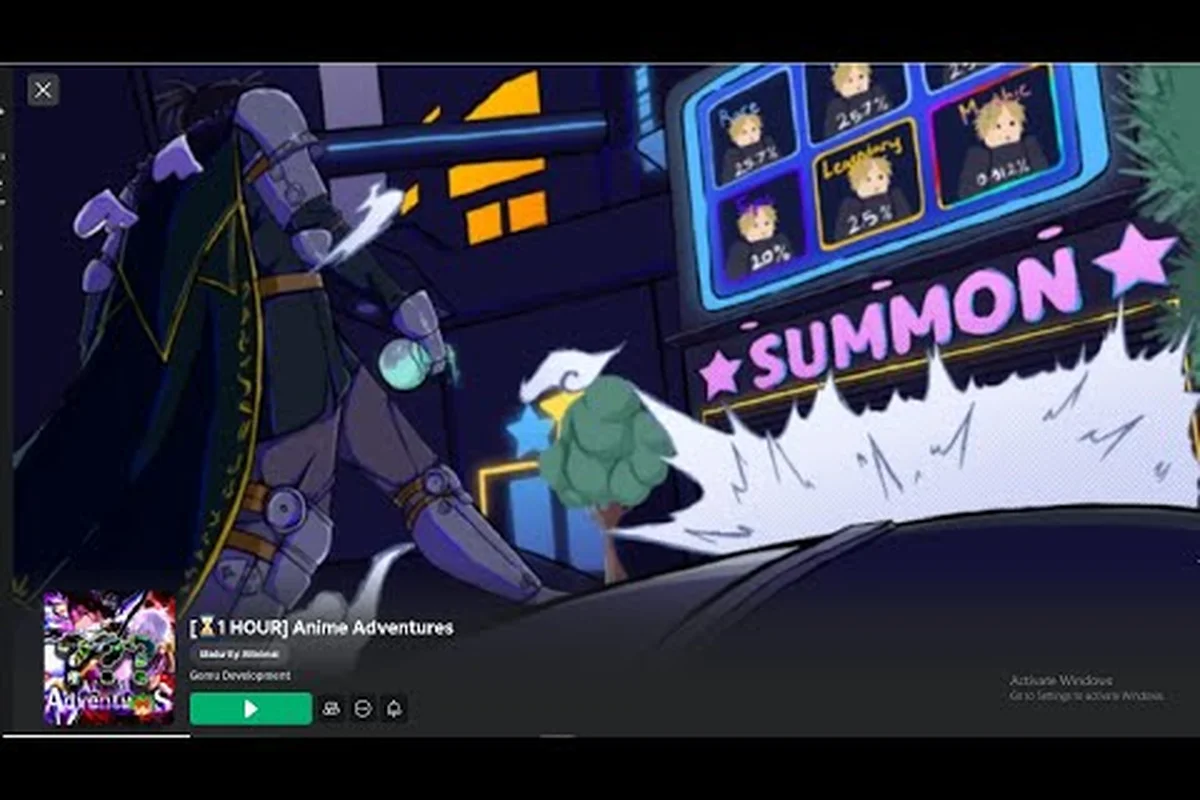
Anime Adventures ability upgrades matter because stronger unit stats directly improve a squad’s wave performance, especially when unit damage, attack speed, and unit levels rise together. A focused upgrade plan concentrates your core fighters instead of spreading resources across the entire roster. For example, prioritizing a main damage dealer’s unit upgrade can produce greater returns than leveling an unused bench unit, while saving priority resources for a unit limit break can further increase that fighter’s damage and combat value.
How Anime Adventures Ability Upgrades Fit Into Unit Progression
The official Anime Adventures game page describes a tower-defense game in which players summon heroes, build a team, and level units to unlock abilities. That makes unit levels the foundation of most progression decisions: each investment can affect a unit’s performance, but the exact numerical gain is not published by Gomu Development.
Anime Adventures unit stats should therefore be evaluated as a decision system rather than a fixed formula. Consider the role a unit fills, the stage you are clearing, and the other upgrade paths available to that character. This approach keeps your choices grounded even when a future update changes balance.
| Upgrade decision | Primary consideration | Best use | Evidence status |
|---|---|---|---|
| Unit level | Ability access and general growth | Core units used in many stages | Officially confirmed progression path |
| Ability enhancement | Effect within the unit’s role | Units already needed in the squad | Exact values not published |
| Limit Break | Additional unit progression | High-investment favorites | Community-documented system |
| Evolution | Post-summon unit development | Units with a confirmed evolution path | Community-documented system |
| Squad position | Practical contribution during waves | Teams with different unit roles | Official tower-defense structure |
Separate Core Stats From Ability Upgrades
Anime Adventures unit damage is best understood as the result of several interacting choices, not a single visible number. A unit’s level, ability, role, and position all contribute to what happens in a wave. Because the developer has not published a complete damage formula, use controlled comparisons instead of assuming that every point produces an identical result.
Record the same stage, wave, and squad conditions when changing one thing at a time. Notice whether the unit contributes more consistently, reaches dangerous targets, or supports the rest of the defense. A small improvement in wave consistency can be more valuable than a theoretical increase that never changes the outcome.
Build a Repeatable Upgrade Checklist
Before committing resources, verify the unit’s identity, current level, unlocked abilities, and available progression options; confirm the exact upgrade path to avoid spending on a duplicate role. Compare the character with another member of the same squad rather than an unrelated unit, tracking unit stats such as damage, ability level, and whether the next unlock improves the skill you actually use in wave defense. For example, a higher-level unit may deal more damage but occupy a less useful role than a lower-level Limit Break target, so check ability upgrades and damage alongside the unit’s contribution to the team.
-
Confirm the unit has a clear role in your current defense.
-
Check whether leveling exposes a new ability or improves an existing one.
-
Compare the character with nearby alternatives at the same stage.
-
Reserve Limit Break or Evolution materials for units you expect to keep.
-
Record results under similar wave conditions.
The Anime Adventures unit priority guide can help organize this broader progression plan, especially when several units compete for the same resources. Use its unit levels, damage, ability, Limit Break, and Evolution criteria to build a short upgrade order rather than spreading materials across every character. For example, prioritize a unit whose next ability level directly strengthens your current wave-defense role, then compare its damage contribution with a lower-level alternative before committing rare Limit Break resources; the best investment is the unit that improves both team coverage and repeatable results.
Choosing Unit Stats by Defensive Role
Strong anime adventures unit stats begin with role clarity. A unit that handles direct damage, one that protects the team, and one that supports other fighters should not be evaluated with the same questions. The most useful upgrade is the one that strengthens the responsibility that unit already performs well.
| Unit function | Stat to watch first | Upgrade signal | Secondary check |
|---|---|---|---|
| Direct attacker | Damage performance | More consistent enemy pressure | Ability activation during the wave |
| Frontline defender | Survival and hold value | Team loses fewer positions | Coverage across several waves |
| Support unit | Effect usefulness | Squad behavior improves | No useful window or duration |
| Generalist | Flexibility | Useful across varied stages | Stable contribution without a specialized setup |
Prioritize Units That Solve a Current Problem
Anime Adventures unit damage matters most when a unit closes a specific gap in the defense. If a stage is ending before the team can build momentum, improving a dependable attacker may be more useful than developing a unit that is rarely placed. If units disappear too quickly, examine the frontline and its defensive contribution before chasing damage.
Community experience and beginner videos describe several progression systems—Summon, Evolution, Starfruit, Relic, and Limit Break—but they do not provide a complete published stat table. Treat those systems as documented by community coverage, and confirm the current requirements in the game before spending materials.
Compare Like-for-Like Scenarios
A meaningful comparison holds constant the stage, wave count, and team composition. Test one upgraded unit against an unchanged alternative, then repeat the result in another stage. This method reveals practical trends without pretending that a player report is an official balance chart.
| Test result | Likely conclusion | Next investment decision |
|---|---|---|
| Clear improvement across multiple stages | The upgrade is broadly useful | Continue developing that unit |
| Improvement in one narrow stage | The unit may be stage-specific | Use it strategically rather than overinvesting |
| No visible change | Role overlap or weak activation may be the issue | Review placement and ability conditions |
| Better result when another unit changes | The team has a synergy condition | Improve the supporting unit next |
Unit Levels, Damage, and Upgrade Timing
Anime Adventures unit levels create a clear upgrade path, but level alone does not identify the best target. Compare the character with every unit that would occupy the same slot. If two units can perform a similar defensive job, the lower-level character may be the more efficient choice because it can reach the next ability milestone sooner.
Because Gomu Development has not published level caps, material totals, or exact damage values, avoid planning around a numerical ceiling. Instead, use the next visible milestone as the planning horizon. The practical question is whether the next upgrade unlocks a new ability, strengthens an ability that regularly activates, or merely creates a small increase without changing team performance.
Use the Next Milestone as the Planning Horizon
An anime adventures unit upgrade becomes easier to evaluate when you can name the milestone it produces. “Increase stats” is vague; “reach the next level and unlock another ability” creates a testable goal. If the new ability does not fit the unit’s assignment, a different unit may offer more value.
| Reason to upgrade | Keep it when | Pause it when |
|---|---|---|
| New ability unlocks | The ability improves the current role | The role is already crowded |
| Existing ability improves | It activates during normal waves | It rarely affects the encounter |
| Core stat rises | The character is a dependable squad member | A stronger teammate can fill the slot |
| Limit Break becomes available | The unit is a long-term centerpiece | The unit is mainly a temporary backup |
Treat Unit Damage as a Team Outcome
A unit with strong anime adventures unit damage can still be less valuable than a balanced teammate. Damage that arrives after the defense has collapsed may not change the result, while a shorter activation window or useful protective effect can preserve the unit’s contribution. Because the game page presents Anime Adventures as a tower-defense experience, wave timing and position deserve attention alongside raw output.
A controlled log helps isolate the cause: compare unit stats before and after an Anime Adventures unit upgrade, including damage, ability level, and unit level, while keeping position and team composition fixed. For example, if a unit’s attack rises but the team stops reaching wave 10, the added Anime Adventures unit damage may be arriving after the defense breaks, or the upgraded ability may not trigger in time. This makes an Anime Adventures ability upgrade easier to evaluate as a timing-and-role change rather than a simple power increase.
-
Record the unit’s assigned position and nearby teammates.
-
Note when its key ability becomes available.
-
Mark whether the team reaches later waves after the upgrade.
-
Keep the test sample large enough to avoid reacting to one unusual run.
-
Repeat with the previous setup to confirm the change.
The Anime Adventures best unit combination guide can help you maintain a varied squad, which makes upgrade comparisons cleaner because each character has a clearer purpose. For example, keep a high-damage attacker behind a front-line blocker, then compare its upgraded Anime Adventures unit stats with the same unit before the change; this separates the gains from an Anime Adventures ability upgrade from the protection and ability timing provided by teammates. Checking the team’s Anime Adventures unit levels, unit limit break, and available Anime Adventures unit damage also prevents a stronger individual unit from masking a role imbalance that only appears during later waves.
Limit Breaks and Long-Term Unit Investment
An anime adventures unit limit break represents a committed progression path, and community guides treat it as one of the game’s unit development layers. The reviewed sources do not publish the exact requirements, benefits, or costs, so the safest strategy is to verify those details in the game before selecting a target.
Limit Break is most defensible when the unit already earns a permanent place in your roster. Favor that character when its role remains useful across the stages you play, its abilities activate during ordinary encounters, and you are comfortable reserving materials for a multi-step investment. Avoid treating it as a generic damage button for every character.
Limit Break Decision Criteria
| Factor | Positive signal | Caution signal |
|---|---|---|
| Roster use | Appears in several stages | Used only for one difficult stage |
| Role value | Fills a role not covered by another unit | Duplicates a stronger teammate |
| Resource plan | Materials can be reserved without blocking basics | Requires spending everything immediately |
| Account direction | Supports long-term squad goals | Conflicts with upgrades for active units |
Balance Long-Term and Immediate Upgrades
Limit Break planning should not crowd out practical progression. A new player may gain more from basic unit levels, a usable team, and access to additional abilities than from fully pursuing a favorite. Older accounts can plan deeper investments once their core squad is stable, but even then, the next available unit milestone may produce more immediate value.
A practical split is to keep a baseline reserve for raising active units, then direct leftover materials toward a favorite’s Limit Break. This is not a published drop-rate or reward formula; it is a resource-planning method that helps avoid committing every material to one character. The Anime Adventures upgrade materials guide provides a focused place to organize material categories and planned spending.
A Practical Ability Upgrade Plan for Every Unit
Every anime adventures unit upgrade should have a purpose attached to it. Begin with the units that appear in the most repeated content, identify the stat or ability that limits their performance, and make one change at a time. This creates a clear cycle from evaluation to testing to reinvestment.
Step 1: Audit the Active Squad
List the units you use, their positions, their current levels, and their visible abilities. Mark whether each character is a primary attacker, a frontline holder, a support, or a flexible reserve. Do not include a character solely because its rarity label sounds strong; roster relevance should decide who receives the next materials.
Step 2: Choose One Clear Objective
Pick an objective that can be checked in normal play, such as unlocking a specific unit ability, stabilizing a frontline hold, or preparing a favorite unit for Limit Break. Track the change through unit levels, unit stats, and observed combat results; for example, if the goal is stronger unit damage, compare the same skill before and after the relevant upgrade instead of relying on appearance alone. This creates a clear benchmark for evaluating each unit upgrade path in the table below.
| Objective | Measurement | Upgrade path |
|---|---|---|
| Reach a new ability | Ability becomes available | Increase unit levels |
| Strengthen a key ability | More consistent activation effect | Ability-focused upgrade |
| Improve defense stability | Team holds position longer | Review frontline stats |
| Develop a long-term favorite | Milestone becomes available | Consider Limit Break |
| Fill a missing role | New contribution is visible | Level the matching unit |
Step 3: Test Without Confounding Changes
Keep the stage and team arrangement stable when possible. This makes it easier to determine whether anime adventures unit damage or another stat actually changed. If you need to alter the team, note the change and compare against another run with the same lineup.
Step 4: Review After Each Milestone
After each upgrade, check the objective again. Continue if the result is clear, adjust if the ability does not match the role, and stop if another unit provides better value. This is more reliable than following an unnamed “priority” unit because the game’s published material requirements and exact stat values can change with updates.
Step 5: Reserve for Team Gaps
Set aside a portion of future resources for units that solve a missing role. The game’s premise centers on assembling heroes against threats from multiple worlds, so a balanced roster is more valuable than concentrating every resource into a single damage option. Reroll strategies and Evolution discussions can also affect which characters you expect to keep, as explained in the Anime Adventures reroll strategy.
Common Upgrade Mistakes to Avoid
The largest mistake is treating a visible rarity label as a complete upgrade verdict. Official thumbnails show Rare and Legendary labels, while community guides also use Mythic, Secret, and Limited. These labels can describe a unit, but they do not automatically reveal its role, ability consistency, or fit with the rest of your squad.
Another error is chasing a unit damage increase without checking whether the character survives long enough to matter. Compare both output and wave contribution. A slightly weaker unit that remains active can produce a better result than a stronger option that leaves the defense early.
Separate Confirmed Facts From Community Advice
Official information confirms that players level units to unlock abilities and build squads, but the available details do not include exact unit damage values, level caps, or material counts. Community coverage identifies progression systems such as Evolution, Starfruit, Relic, and Limit Break, so treat those names as documented mechanics rather than fully specified stat boosts. When deciding whether an anime adventures unit upgrade is material-heavy, compare the next visible ability or Level milestone instead of assuming that every increase in unit levels improves overall performance.
| Claim | How to treat it | Reason |
|---|---|---|
| Units can level and unlock abilities | Confirmed by the official game page | Core gameplay description |
| Limit Break exists | Community-documented system | No detailed official benefit published |
| Exact unit damage values | Unpublished | No official damage table found |
| Level caps and material counts | Unpublished | No reliable official numbers found |
| Named unit rankings | Avoid unsupported placements | Only limited names are verifiable |
| Future update rewards | Unconfirmed | Dates and details are not published |
The final mistake is assuming that more levels always equal a better roster. If the next level does not change the unit’s role or improve an ability that regularly activates, a different unit may create a larger return. Compare the next visible milestone, test it, and then continue investing.
Frequently Asked Questions
What are the best stats to prioritize in Anime Adventures?
Prioritize the stat that supports the unit’s role: damage for attackers, survival for frontline defenders, and useful ability effects for support units. The exact stat names, values, and level caps are not published by Gomu Development, so compare units under the same stage and team conditions. Choose upgrades that change normal wave results rather than relying on rarity alone.
How should players decide which unit to upgrade first?
Upgrade the unit that appears in your regular squad and solves a current defensive need. Check its next level or ability milestone, compare it with another unit in the same role, and test the change in a similar stage. If another character reaches a meaningful ability sooner, that unit may deliver more immediate value for the same resource period.
Does a Limit Break always increase unit damage?
A Limit Break should not be assumed to provide a specific damage increase because its exact effects and percentages have not been published. Treat it as a long-term unit development option, especially for characters you expect to keep. Verify the displayed benefits in the game, then test whether the unit contributes more consistently before committing further materials.
Are unit levels more valuable than other upgrade materials?
Not universally. Unit levels are officially connected to unlocking abilities, making them a clear early priority, but material types and exact benefits can depend on the unit and current system requirements. Use the next visible milestone as your guide, reserve enough resources for active squad members, and avoid sacrificing basic progression for a single favorite.
How can players compare damage without official damage values?
Run the same unit in identical or closely matched stages, keep the surrounding squad stable, and record when abilities activate and when the defense loses its position. Compare several runs instead of treating one outcome as proof. This reveals practical gains in anime adventures unit damage without depending on unpublished formulas, community tier labels, or invented numerical benchmarks.