
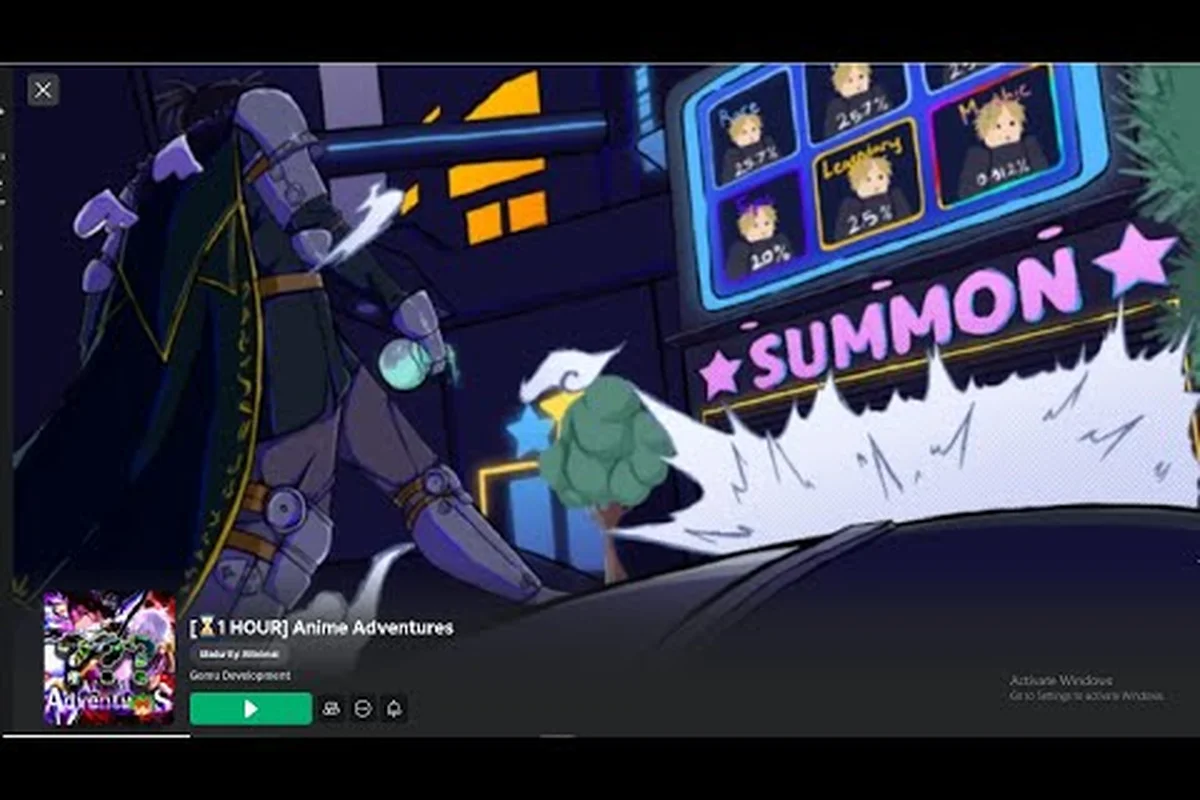
Anime adventures getting started is easier when you understand the core loop: summon a roster, build a team, place units, and survive waves. This anime adventures beginner guide shows you how to make early choices without wasting resources on uncertain rewards.
What the Anime Adventures Beginner Guide Should Cover
Anime Adventures is a Roblox strategy and tower-defense game from Gomu Development. The official game page describes a world-spanning crisis that draws heroes together, while players collect characters, lead anime units, and defend against incoming waves. Because the game combines collection with real-time positioning, learning the basic systems gives you a stronger foundation than rushing toward advanced content.
The official Anime Adventures game page on Roblox identifies it as a strategy and tower-defense experience. The page also warns that similarly named games are not affiliated with Gomu Development, so checking the correct place ID is important when following a guide.
The Core Beginner Loop
Every useful anime adventures beginner tip follows the same broad progression. First, acquire characters through the Summon system. Next, examine what the roster can contribute and choose a dependable main damage unit. Then, place units where they can attack effectively, level the team, and strengthen the unit that carries your runs.
| Stage | Main objective | Beginner decision |
|---|---|---|
| Summon | Add characters to the roster | Build variety without assuming every pull is equally useful |
| Team setup | Create a balanced squad | Prioritize one dependable damage unit |
| Story waves | Practice placement and timing | Learn the encounter before spending resources |
| Unit growth | Improve the damage carry | Level the unit that clears content consistently |
| Advanced modes | Add dungeons, raids, and other systems | Expand only after the opening loop feels comfortable |
This sequence matters because progression systems sit on top of the basic combat loop rather than replacing it. For example, improving a damage carry through unit growth only pays off when that character is positioned within attack range and protected from enemies targeting the frontline. A broad roster is useful for team setup, but adding Summon characters without a clear damage focus can dilute resources and leave Story waves harder to clear. Test placements on an easy wave, watch which unit survives, then concentrate leveling and gear on the character that consistently produces the strongest results.
Verified Facts to Keep in Mind
The official game page was created on December 17, 2024, and showed an update on October 4, 2026. At the time of the October 2026 research pass, it displayed 323,483 visits, 1,832 favorites, and a 30-player server cap. These are public counters rather than promises about the current number of active players.
The current content cycle was Update 20, while community coverage was preparing for Update 21. No reviewed source supplied a dated Update 21 release, summon rates, level caps, damage values, reward amounts, or drop tables. Treat any precise number that lacks an official source as unverified, especially when it changes between updates.
Summoning and Building Your First Roster
Summoning is the entry point to progression, but an early collection does not need every available character. The goal of this anime adventures getting started plan is to create enough choices to cover the opening story, identify a main damage unit, and preserve resources for upgrades when their value becomes clearer.
The official game page mentions gems and a limited unit received upon release. Community guides also discuss Starfruit, Relic, and Limit Break, although these are community-reported systems rather than details confirmed in official patch notes. No active code was verified during research, so avoid planning around an unconfirmed code.
Choosing a Damage Anchor
A starter team should have a clear Primary Damage Anchor: the character that you expect to lead most early clears. You do not need a published damage ranking to make this decision. Test the characters available to you, observe which one consistently helps you finish waves, and give that unit priority when resources are limited.
Only two unit names had verifiable community mentions in the reviewed material: Rukia and Fusion Vegeto. Community players have mentioned both, but that does not create an official tier order. Use them as examples of characters the community has discussed, not as guaranteed best choices for every account.
| Evaluation point | What to observe | Why it matters |
|---|---|---|
| Wave consistency | Whether the unit remains effective through several encounters | A reliable anchor supports longer runs |
| Range and coverage | How it works with the rest of the squad | Team placement affects practical output |
| Upgrade value | Whether leveling it creates a visible improvement | Concentrated growth can simplify early planning |
| Resource cost | Whether the unit requires rare materials to become useful | Avoid committing scarce items too early |
| Availability | Whether you own it and can deploy it immediately | Immediate usefulness beats an untested future plan |
This decision does not require invented damage percentages. A clear leader based on actual play is more reliable than an unsupported ranking, because your available roster, current stage, and team composition determine the practical result. For example, if both Rukia and Fusion Vegeto are available, compare their wave consistency, range and coverage, upgrade value, resource cost, and immediate availability, then test them in the same early encounter. The unit that reliably contributes to wave clears, fits the team’s role, and improves when upgraded should receive your first concentrated resource allocation.
Spending Gems Carefully
Community beginner videos frame the first session around learning placement and wave timing rather than spending every gem immediately. That is sound advice because early experimentation teaches how different characters affect a fight. Save unneeded gems until you understand whether a summon, upgrade, or another option is the better use.
| Gem decision | Beginner approach | Reason |
|---|---|---|
| Broad roster testing | Spend selectively | Learn which characters fit the opening stages |
| Automatic repeated summons | Pause | Repeated spending does not guarantee a useful result |
| Main damage growth | Favor after testing | Concentrated progress can improve team consistency |
| Rare feature systems | Investigate first | Community details may be outdated or unverified |
The official Anime Adventures Discord is linked from the game page and is used for announcements, event discussion, and team help. It listed 662,720 members with 145,703 online during the research pass, although chat claims, drop rates, and tier placements should still be checked against official information when possible.
Anime Adventures How to Play: Positioning and Wave Timing
Learning anime adventures how to play begins with reading the battlefield rather than watching only your strongest unit. Tower defense rewards practical coverage, so placement should help multiple units contribute while keeping the team capable of handling threats that arrive from different directions.
Because the reviewed sources do not publish exact unit ranges, attack speeds, or enemy behavior, the best advice is observation-based. Start with a normal formation, note where enemies move, and then adjust your layout. This anime adventures beginner tips section focuses on repeatable decision-making instead of invented stat breakpoints.
Start With a Simple Formation
Your first formation needs to be understandable, not elaborate. Place units where you can see their attacks, keep the main damage unit in a position that contributes during the longest part of the wave, and avoid filling every available space before you understand the encounter. Empty space can sometimes be more useful when it gives a unit time to attack.
| Placement choice | Likely result | Beginner test |
|---|---|---|
| Spread across the route | Coverage of several approach points | Watch whether attacks overlap or waste time |
| Concentrated near one lane | Higher consistency in a predictable area | Test whether enemies later use another route |
| Centered core damage unit | Simple focus for the whole team | Compare with a split arrangement |
| Units placed only at spawn | Quick early action | Check whether later targets are missed |
The useful comparison is not “one placement wins.” It is which placement lets you complete more waves with fewer unnecessary losses. Community reports often provide specific setups, but exact coordinates or unit orders are not confirmed by the official page, so verify any recommendation in practice.
Learn the Wave Rhythm
Each attempt should answer a few simple questions. Where did the first group enter? Which unit handled it? Did your damage anchor stay active, or did attention shift elsewhere? When did the encounter become difficult, and which position created the clearest cause?
Record the result after each attempt because wave timing becomes easier to recognize when you can compare failures. If enemies consistently reach a weak area, reposition the unit responsible for that side. If your main attacker spends too long out of range, shift the formation rather than immediately blaming the roster. For a more detailed view of early encounters, the Anime Adventures first-hour guide expands on learning stages without relying on unverified thresholds.
When to Change the Team
Change the team when a practical problem repeats, not merely because a new character appears. A new unit should earn its place by improving coverage, handling a weakness, or becoming a more consistent main damage option. Otherwise, keep the current setup long enough to learn it properly.
| Observation | Change to consider | Avoid this mistake |
|---|---|---|
| Main attacker cannot cover the full route | Adjust formation or add complementary coverage | Replacing the entire team immediately |
| One character performs well across repeated waves | Make that unit the primary growth target | Spreading upgrades across every new pull |
| The squad feels unpredictable | Return to a simpler formation | Copying a team without matching units |
| A new unit performs inconsistently | Test it in a controlled attempt | Promoting it based only on rarity |
Rarity labels shown on official thumbnails include Rare and Legendary, while community guides also use Mythic, Secret, and Limited. Those labels can describe collection status, but they do not automatically determine which character will fit your available stage or squad. Use rarity as context, not as a replacement for testing.
Early Progression Without Wasted Resources
The most effective anime adventures tips and tricks are about sequencing. Community guides describe a layered path: summon a roster, settle on one main damage unit, clear the opening story waves, evolve the unit that carries runs, and then add dungeons, raids, relics, and Limit Break. This order is practical because it postpones advanced spending until the basic squad works.
Official information confirms that players can level units to unlock abilities and build squads. It does not publish the level cap, ability thresholds, evolution requirements, or exact costs, so avoid stating that a unit becomes “optimal” at a specific level without reliable evidence.
Build Around One Proven Unit
Your early account is strongest when a single dependable character can carry much of the workload. Level that unit, test the improvement, and then decide whether the next upgrade should strengthen the same damage anchor or add a complementary role.
Main Damage Anchor
Choose a character whose value is supported by consistent performance in early Story Mode, wave, and dungeon stages, not by rarity labels, community tier lists, or one dramatic summon animation. For example, if that unit repeatedly clears waves and contributes enough damage to finish a dungeon boss, it is a stronger foundation than a newer unit that performs well in only one showcase battle. Use clear stages, repeatable clears, and usable ability unlocks as the main evidence before investing in this unit’s evolution, relic, or Limit Break upgrades.
Roster Breadth
The number of distinct characters available for different encounters is less important than how many can reliably join your active team. For example, if a damage anchor clears Story Mode waves and contributes meaningfully to a dungeon boss, that character deserves Unit EXP and ability-unlock resources before a rarer unit joins the roster. Roster breadth becomes waste when evolution materials, relics, or Limit Break progress are spread across characters that never enter your main team.
Upgrade Focus
This deliberate concentration of levels, Unit EXP, ability-unlock materials, and evolution resources on one proven damage anchor creates a clear upgrade order. For example, if that character already handles Story Mode waves and supplies a substantial share of your dungeon boss damage, improving its level and unlocking its key ability can raise clear speed before you spend scarce Evolution materials, Relics, or Limit Break resources. Compare the anchor’s performance before and after each upgrade, then reserve a secondary character for a complementary role rather than spreading limited progression across multiple unproven units.
| Progression layer | What it depends on | Recommended beginner timing |
|---|---|---|
| Summoning | Available characters and gems | Build a workable roster before repeated spending |
| Unit leveling | Levels and ability unlocks | Prioritize the proven damage anchor |
| Evolution | Community-reported system | Develop the unit that already carries runs |
| Relic | Community-reported system | Add after the main squad is stable |
| Limit Break | Community-reported system | Investigate requirements before committing resources |
| Dungeons and Raids | Suitable team and progression | Introduce after basic wave play is comfortable |
Because exact requirements are unavailable, take a screenshot or check the interface for current costs and conditions. A future update may change the order or thresholds, and a guide that admits uncertainty remains more useful than one presenting guesses as facts.
Use a Three-Check Resource Routine
Before spending on any uncommon resource, ask three questions. Does this directly improve the unit that clears my current stages? Can I test the result without disrupting the main team? Have I checked the current in-game requirement instead of relying on an old community guide?
| Check | Keep the purchase when | Delay it when |
|---|---|---|
| Role value | It strengthens a proven core unit | It rewards an untested character |
| Testability | You can measure the outcome in the same content | It changes your only dependable formation |
| Source quality | The requirement appears in the current game | A community post provides unsupported numbers |
| Opportunity cost | It fits the next progression layer | It skips several earlier improvements |
This routine also protects against Reroll assumptions. Although rerolling appears in community coverage, the reviewed sources do not establish a universal reroll cost or rule. Check the current interface before using a system that may behave differently after Update 20 or during a future content cycle.
Preparing for Dungeons, Raids, and Events
Dungeons, raids, Infinite Mode, and limited-time events expand the game beyond the opening story. They also introduce more variables, which is why beginners should prepare deliberately. The Anime Adventures current event reference can help organize event information, while community claims about rewards or schedules should remain clearly separated from official announcements.
Because only the basic game loop is described in detail by official sources, this section focuses on preparation principles rather than exact reward thresholds. You will make better decisions when you know what your team must do before asking it to handle a more demanding mode.
Build a Mode Checklist
Use the same checklist for a new dungeon, raid, Infinite Mode attempt, or event. Confirm that the main damage unit is available, review the encounter when possible, and avoid changing multiple variables at once. If a run fails, change one thing so you can understand the result.
| Preparation layer | Check before entering | Question to answer |
|---|---|---|
| Core roster | Is the main damage unit ready? | Can the team handle basic pressure consistently? |
| Composition | Does the squad cover the encounter? | Are multiple units contributing? |
| Resources | Are rare materials reserved? | Could this attempt consume upgrades needed elsewhere? |
| Knowledge | Is the objective clear? | What must the team accomplish? |
| Review | Have similar attempts been attempted? | Is this a genuine improvement test? |
For team composition, compare the Anime Adventures best dungeon team reference with the characters you actually own. A team guide can offer a framework, but it cannot replace a missing unit or prove that an unverified setup is the best available option.
Distinguish Announcements From Rumors
The official game page and the developer’s linked channels are stronger evidence than chat speculation. Community reports can help you notice an issue or understand player sentiment, but a date, reward amount, summon rate, or tier placement should be treated as unconfirmed until Gomu Development publishes it.
A useful event check includes the official game page, the linked official Discord announcements, and the developer’s YouTube channel. If those sources disagree, prioritize the most recent official notice. The public Discord is enormous, and real-time chat can be outdated within minutes, so screenshots of a community message should not be treated as a permanent rule.
| Information type | Best source | How to treat it |
|---|---|---|
| Premise and core gameplay | Official game page | Confirmed |
| Release announcement | Official game page or official channel | Confirmed when posted there |
| Event discussion | Official Discord | Confirm rewards and dates officially |
| Team recommendation | Community guide | Test with your roster |
| Summon rates or exact drop tables | No verified reviewed source | Do not present as fact |
| Update 21 release date | No verified dated announcement | Do not invent one |
Practice Before Spending Everything
The first purpose of an advanced mode is not loot. It is testing whether your current setup can handle a new situation. Enter after your basic team is stable, keep a note on what changed, and preserve flexible resources for a second attempt. This approach also helps when an event ends: the knowledge remains useful even if the rewards are gone.
Common Beginner Mistakes and Better Decisions
Most mistakes in this anime adventures beginner guide come from mixing collection decisions with combat decisions. A rare character does not automatically improve every encounter, and a new system does not need to be unlocked before the foundation is stable. Recognizing those distinctions prevents unnecessary spending and repeated team changes.
| Common mistake | Why it hurts | Better decision |
|---|---|---|
| Treating rarity as a tier list | A label cannot show fit with your roster | Test practical performance |
| Spending every gem immediately | It removes room for informed choices | Keep unneeded gems reserved |
| Leveling every character equally | Progress becomes scattered | Focus on the main damage unit |
| Copying teams without matching units | The advice may not be possible for your account | Adapt the plan to your roster |
| Believing unverified exact numbers | Rates and thresholds may be wrong or outdated | Check the current interface |
| Chasing the newest event immediately | Weak foundations limit results | Stabilize the core team first |
| Changing everything after one loss | The cause becomes impossible to identify | Change one variable at a time |
These are not merely efficiency tips: controlled tests reveal how unit placement affects damage, cooldowns, and targeting, and how team needs change between Story Mode stages and tougher battles. For example, if one unit underperforms, test a different position or a different partner before upgrading anyone, then compare the result against your main damage unit’s output. This isolates the variable, builds a more accurate anime adventures how to play strategy, and prevents a single loss from triggering unnecessary stat, gem, or roster changes.
Separate Collection Value from Combat Value
A collection game naturally encourages you to value every new character. Combat requires a narrower question: does this unit improve the squad now? A character can be desirable without being the best main damage anchor, and an anchor can be useful without claiming the highest rarity.
Keep two lists in mind. The first is your available roster, including unit names, rarity, and any current role you observe. The second is your tested active team, with the units that repeatedly help you clear stages. The second list should guide spending, while the first helps you recognize future opportunities.
Learn What Community Sources Can and Cannot Confirm
Community experience is useful for discovering things the official page may not explain, such as general player strategies for dungeons or raids. It is less reliable for exact costs, release dates, rarity rankings, and drop information. Treat community-reported Evolution, community-reported Starfruit, community-reported Relic, community-reported Limit Break, community-reported Infinite Mode, and community-reported Reroll as useful leads that still require an in-game check.
The same distinction applies to the broader anime adventures tips and tricks found online. A strategy can work because of a unit you do not own, a temporary event modifier, or a newer patch balance. Always ask what prerequisites the advice assumes before applying it.
A Practical First-Session Plan
A focused first session should produce a usable team, not a complete collection. Start with the current opening stages, summon as needed to create options, test your characters, and select the unit that carries the clearest run. Level that unit only after you understand how it performs.
First Session Checklist
Complete each stage in order so your first session develops a reliable combat loop before you spend rare materials. For example, test Story Mode waves with a small squad, note which unit reaches enemies first, and adjust positioning if damage is spread too thinly. A checklist prevents the common mistake of upgrading multiple characters or consuming rare resources before the starter team can clear basic stages consistently.
- Confirm that you are using the official Anime Adventures place linked from the game page.
- Summon enough characters to form a functional squad.
- Identify the character that contributes most consistently to early clears.
- Place units in a simple, readable formation.
- Finish the opening story waves while observing enemy routes and unit coverage.
- Level the main damage unit instead of spreading resources across the roster.
- Revisit the formation and change one element after an unsuccessful attempt.
- Keep uncommon resources until the basic team performs consistently.
- Check current in-game requirements before using advanced systems.
- Record what worked so the next session begins with useful knowledge.
What Success Looks Like
The goal of the first session is not a perfect squad. It is a clear answer to three questions: Which unit is carrying your progress? Which formation gives that unit the best chance to act? Which resources are still available for the next improvement?
| Time horizon | Reasonable goal | Avoid |
|---|---|---|
| First session | Learn placement and identify a damage anchor | Chasing every available summon |
| Early account | Stabilize the main team and story clears | Assuming a community tier label is universal |
| Medium term | Add dungeons, raids, Relic, and Limit Break carefully | Skipping core progression for one event |
| Later | Adapt the team to new modes and updates | Treating old numbers as permanent |
The game’s public audience has grown substantially, but popularity does not make every online recommendation reliable. The official page showed more than 323,000 visits and nearly 1,832 favorites at the research point, while the official Discord listed hundreds of thousands of members. Use that community access to ask well-informed questions, but verify the answer.
Frequently Asked Questions
What is the best unit for beginners in Anime Adventures?
There is no officially published beginner ranking, so there is no verified universal answer. Community sources mention Rukia and Fusion Vegeto, but neither has an official tier placement. Test the characters you own, select the one that clears early waves most consistently, and make that unit your main damage anchor before spreading resources across the roster.
Should beginners spend all their gems immediately?
No. Community beginner videos emphasize learning placement and wave timing before committing every gem. The official page mentions gems but does not publish summon rates, so repeated spending is not guaranteed to produce a better result. Keep some gems reserved until you understand your roster and have identified a unit worth developing.
Which progression system should a beginner prioritize first?
Prioritize leveling the unit that consistently carries your opening waves, then investigate Evolution and the main damage anchor. Community guides describe Relic, Limit Break, dungeons, raids, Infinite Mode, and other layers as later goals. Because exact thresholds and costs are not published, check the current in-game requirements rather than relying on a specific milestone.
Can a beginner team clear dungeons and raids right away?
Not necessarily. A dungeon or raid introduces different objectives and pressure, so a team that only handles basic story waves may need adjusted placement or composition. Test the mode with the characters you own, change one variable after a failure, and use the Anime Adventures best dungeon team reference as a framework rather than a guaranteed roster.
Are summon rates, codes, and Update 21 dates confirmed?
No verified source in the reviewed material supplied summon rates, active codes, or a dated Update 21 release. The current cycle was Update 20 during the October 2026 research pass, and the official page showed an update on October 4, 2026. Check the official game page and developer channels for current information instead of planning around unverified community claims.
The strongest anime adventures beginner guide strategy is simple: summon with purpose, test a clear formation, concentrate growth on one reliable damage unit, and verify advanced requirements in the current game. That sequence turns collection into a steady progression plan while reducing wasted gems and unsupported decisions.