
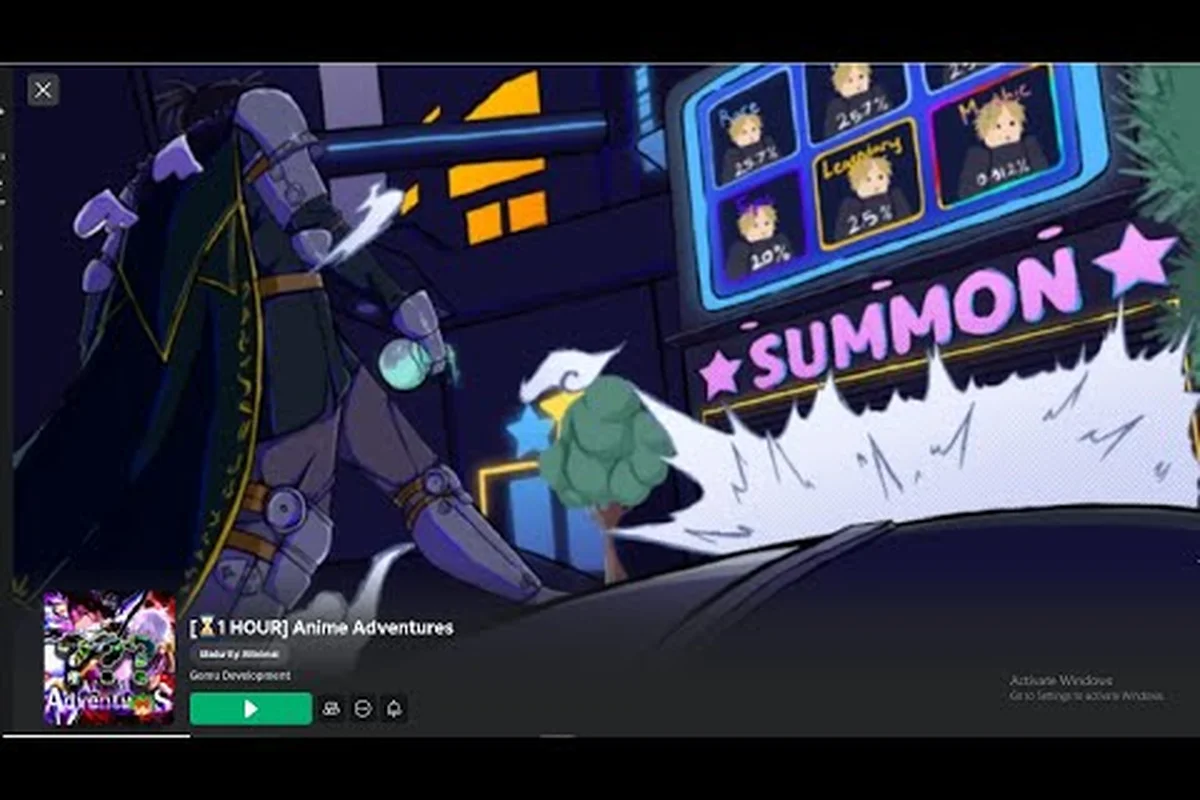
Learning how to summon wisely in Anime Adventures matters because your first pulls shape the squad you build, while every upgrade resource spent too early can leave you short later. Learn the practical decisions, not invented rates, so you can focus on the verified progression path.
How Anime Adventures Summoning Fits the Bigger Picture
Anime Adventures is a Roblox strategy and tower-defense game from Gomu Development. Its official game page describes a world-crossing crisis in which players summon heroes, collect unique characters, level units to unlock abilities, and assemble a squad against incoming waves. That makes summoning the starting point of roster development, not a substitute for learning placement and wave timing.
The practical question behind “anime adventures how to summon” is not simply which button to press. It is how to choose a target, protect limited resources, and decide when a new character deserves a place in your team. Because published rates and banner details are not available, a useful strategy must focus on the information players can observe inside the game.
| Summoning consideration | Beginner-friendly decision | Why it matters |
|---|---|---|
| Roster goal | Build a balanced team instead of chasing duplicates | Coverage is more useful than collecting many similar units |
| Main attacker | Select one dependable damage unit | A clear role makes wave defense easier |
| Upgrade target | Invest in the unit you already use most | Progress feels more efficient when tied to real play |
| Resource timing | Delay optional spending until the roster has a clear purpose | Keeps options open for later progression |
| Banner information | Read the current in-game banner details | No reliable rates are published outside the game |
Beginner videos emphasize learning unit placement and wave timing during the first session rather than spending every gem immediately. That lesson also shapes a sound pull plan: summon to create options, test those options in combat, and then upgrade the characters that repeatedly earn a place in your squad. For a wider view of unit categories, the Anime Adventures Unit Index can help organize a growing roster without treating community rarity labels as confirmed tier rankings.
Start with a roster objective
Before summoning, decide what the roster must accomplish. A small team can contain a primary attacker, a different type of damage dealer, and support or control units, although the exact roles and their effects must be checked on the unit’s in-game information. The official page confirms that players build squads and unlock abilities by leveling units, so selection should be tied to battlefield usefulness.
A good beginner target is not the rarest name visible in a preview. It is a character that fits a missing role, performs reliably in the content you can access, and leaves room for future additions. The community has mentioned Rukia and Fusion Vegeto, but neither name has enough verified information to justify a fixed recommendation. Judge available units by their displayed information and your own results instead.
Trial Pulls Without Committing
Treat early pulls as experimental samples. After each meaningful set of pulls, place the new characters in practice or story waves, observe their contribution, and compare that experience with your current core squad. A strong-looking unit is only as valuable as the play it enables.
This approach also prevents a common mistake: filling every open slot simply because a character is new. Keep spare units until their role is clear. A compact squad that you understand is usually more useful than a crowded roster that you cannot evaluate or upgrade efficiently.
Choosing a Summon Target Without Published Rates
Gomu Development has not published verified summon rates, drop tables, pity counters, guaranteed-pull rules, or numerical banner costs in the sources reviewed for this guide. “Banner picks” therefore means reading the current banner information in the game and setting a target before spending—not claiming that one banner is mathematically better than another.
The current community content cycle is Update 20, while Update 21 material is framed as preparation and speculation unless confirmed by the developer. The official Anime Adventures game page is the safest source for the current release context, while trailers may preview a theme without providing a reward table or unit stat sheet.
| Information shown in-game | What to verify | Decision to make |
|---|---|---|
| Featured character | Whether that character fills a needed role | Summon only if it improves team coverage |
| Rarity label | Whether it is Rare, Legendary, or another community label | Treat rarity as context, not a guaranteed tier |
| Obtainability | Whether the character can be earned elsewhere | Avoid duplicating a freely accessible unit |
| Temporary availability | Whether the banner has an announced end | Plan around what the game actually shows |
| Gem requirement | Whether spending now leaves later goals short | Preserve resources when possible |
| Unit details | Ability, role, and upgrade path | Confirm the unit fits your current squad |
Match the target to a gap
Write down the role your team lacks before opening a banner. If the current lineup struggles against repeated waves because every character fills the same position, look for a different damage type or support function. If one character already handles the needed role well, a duplicate may contribute less than saving for another option.
This method is especially useful for understanding anime adventures how to summon because it replaces guessing with a repeatable decision: identify a gap, review the banner, and compare the candidate with the gap. If the displayed character does not solve that problem, the pull becomes optional rather than automatic.
Remember what remains uncertain
Community resources often discuss concepts such as Summon, Unit, Evolution, Starfruit, Relic, Limit Break, Gem, Dungeon, Raid, Infinite Mode, and rerolls. However, the available official information does not confirm exact costs, reward amounts, or probabilities. Do not build a budget around a rumored number until the game itself displays it.
The official Heaven’s Storm trailer can establish a new theme or character concept, but the trailer does not publish release dates, reward tables, or stat sheets. Likewise, the official page notes that gems and a limited unit will be granted upon release for returning players who missed them. That promise is useful context, but it should not be generalized into a guarantee for every banner or repeat pull.
Using Starfruits Without Wasting Progression
Starfruit is described by community guides as a progression material, but it is not the confirmed summon currency. No reviewed source says that Starfruits are spent on summons, banners, or pulls, and there is no verified Starfruit price to quote. That distinction is essential when learning anime adventures how to use starfruits.
In practical terms, treat Starfruits as resources for later character development rather than pull tickets. Save them until you have a unit whose progression you understand and intend to keep. Spending them on an untested character can leave you with a weaker team and fewer resources for the upgrades that actually improve your clear rate.
| Resource | Confirmed use in reviewed sources | Beginner approach |
|---|---|---|
| Starfruit | Progression material reported by community guides | Save for a unit with a clear place in the squad |
| Gem | Summoning currency referenced on the official page | Pull only after setting a banner target |
| Relic | Progression system reported by community guides | Review its exact effect before committing |
| Limit Break | Progression system reported by community guides | Check the displayed requirement before spending |
| Evolution | Upgrade path reported by community guides | Favor the character you use most often |
Tie Starfruits to one dependable unit
Choose one character as your first progression focus. It should already be part of regular clears, have a role that fits future content, and offer a clear upgrade path. Community reporting supports the sequence of evolving the unit that carries your runs, but it does not establish a universal level threshold or stat breakpoint, so the in-game requirement is the deciding factor.
For anime adventures how to use starfruits, the safest rule is simple: one committed target beats scattered spending. After upgrading, return to the same stages and compare performance. If the character is still central to your clears, continue the planned progression. If not, reconsider the target before making another investment.
Avoid false economies
A rare unit is not automatically a better Starfruit target than a common unit that appears in every clear. Likewise, a flashy unit with no defined role may be less valuable than a dependable attacker whose ability complements the rest of the squad. Rarity labels visible on official thumbnails include Rare and Legendary, while community guides also use Mythic, Secret, and Limited, but those labels alone cannot substitute for testing.
The Anime Adventures Item Guide is a useful companion for organizing resources, provided each item’s actual function and requirement are checked in the current client. The central goal is not to maximize inventory count; it is to turn limited materials into stronger performance without sacrificing flexibility elsewhere.
Evolving Units and Planning Limit Breaks
Evolution and Limit Break are community-reported progression systems, so the game interface should be the source for each character’s requirements. Neither exact level thresholds nor universal material amounts have been verified. The useful guide to anime adventures how to evolve units is therefore procedural: identify the eligible character, review the displayed requirement, complete it, and then test the upgraded unit in practical waves.
Evolution should normally follow basic summoning. A new character with no established role may not be the right target even if the upgrade screen allows it. By contrast, a unit that already carries your clears has clear value because improved performance can be measured. This sequence aligns with the progression supported by community guides: establish a main damage unit, clear opening content, then deepen that unit’s development.
| Decision point | Evolve now | Wait and reassess |
|---|---|---|
| Role | The unit fills an important team gap | Another character already performs that role |
| Usage | It appears repeatedly in successful runs | It is mostly unused after testing |
| Upgrade path | The requirement is clear and attainable | The game has not explained the requirement clearly |
| Resource value | The character needs a meaningful boost | Other upgrades have a clearer payoff |
| Future plans | It supports planned dungeons or raids | Its role may change as the roster grows |
Evolution order for a new squad
First, clear the opening waves with a functional team. Place units according to their displayed ranges and role, and learn when a stronger unit should enter the lineup. Second, identify the unit that contributes most consistently. Third, review whether Evolution is available for that character and what it requires.
Fourth, test the evolved result against the unupgraded lineup. A useful upgrade should improve your clear experience, whether through survivability, damage, coverage, or another effect shown in the unit details. Fifth, redirect attention only after the first upgrade has been evaluated. This measured order keeps anime adventures how to evolve units connected to actual performance instead of menu completion for its own sake.
Limit Break as a later commitment
Limit Break is another community-reported progression layer. Before using it, check the exact unit, required materials, and effect shown in the current game. The reviewed sources do not support a universal rule that one rarity should always receive a Limit Break first or a fixed number of attempts should be saved. For anime adventures how to limit break, apply the same resource test used for other upgrades:
-
Confirm that the chosen unit remains a core part of the squad.
-
Compare the displayed effect with an unopened upgrade on a dependable teammate.
-
Make sure the required materials are not needed for a clearer near-term objective.
-
Complete the upgrade only when the game’s requirement is fully understood.
-
Test the changed performance before investing further.
This method reduces the chance of spreading resources across too many characters. It also keeps the decision grounded in the game’s current menu rather than a community formula that may be outdated or unverified.
A Beginner Roadmap From First Pull to Stronger Teams
A sensible anime adventures beginner roadmap starts with the official loop: summon characters, form a squad, level units to unlock abilities, and defend against waves. The official game page reported a 30-player server cap and public engagement counters during the October 2026 research pass, but those figures do not affect the personal progression plan. Your priority is understanding a small roster and improving its performance.
The community-reported sequence—summon a roster, settle on a main damage unit, clear the opening story waves, evolve the unit that carries runs, then add dungeons, raids, relics, and Limit Break—provides a sensible roadmap. It does not specify numerical thresholds, reward quantities, or named stages, so use the options that appear in your client rather than searching for invented milestones.
Phase 1: Learn the defense loop
Before optimizing the roster, learn placement, wave timing, and how unit abilities fit together. Keep enough resources to experiment, but avoid assuming that a pull is automatically an upgrade. You can check available gems and Starfruits through the current interface, then make one small decision at a time.
| Beginner checkpoint | What success looks like | What to avoid |
|---|---|---|
| First squad | A few characters with distinct roles | Filling every slot without testing |
| Early waves | You understand placement and timing | Repeating the same arrangement blindly |
| First upgrades | One dependable character improves | Spreading materials across every new pull |
| Resource plan | Gems and Starfruits have separate purposes | Treating Starfruits as a summon ticket |
Phase 2: Establish one main attacker
Let the opening content reveal which character can carry the most runs. Then check the unit’s role, upgrade availability, and effect on squad performance. This is the point where anime adventures how to summon becomes less about collecting and more about selecting. A new character earns a place by improving the lineup, not by having a rarer label.
Keep the unit’s development path in view as you summon. If a new pull offers a different role, compare it with the team’s current weakness. If it does not fill that weakness, save your resources and let the main attacker remain the priority.
Phase 3: Deepen progression selectively
After the first stable clears, examine Evolution, Relics, and Limit Break options. These systems are part of the community-described progression, but exact requirements remain character-specific and should be read directly in the game. Upgrade the unit that produces the clearest improvement, then return to the content you have already cleared.
The Anime Adventures Ability Upgrades guide can help organize what to inspect when comparing a unit’s ability and leveling path. Avoid comparing a new character only by a label or an isolated stat. Consider its range, role, effects, and fit beside the units you already trust.
Phase 4: Broaden the content goals
Once the main attacker supports consistent clears, begin adding the broader activities available to you: dungeons, raids, Infinite Mode, and time-limited events. These are community-identified systems, and the exact unlock order can change with the current update. Do not rush them merely because they appear in a roadmap.
Set one goal at a time and reserve enough resources for the next upgrade. A steady sequence—improve the core unit, test a new activity, add a complementary teammate, then revisit materials—produces more dependable results than a burst of summons without a plan.
Summoning Pitfalls and Safer Alternatives
Most beginner mistakes come from confusing possibility with necessity. A banner may offer a character, but the banner may not solve the team’s current problem. Starfruit may support progression, but it may be better reserved for a unit that already performs well. A new summon can also create pressure to spend on that character immediately, even when another teammate would benefit more.
| Common mistake | Better alternative |
|---|---|
| Pulling whenever a banner appears | Choose a target based on the roster gap |
| Assuming a community rarity label is a tier | Read the unit details and test its contribution |
| Spending Starfruits on summons | Keep them for confirmed progression systems |
| Evolving every new character | Upgrade the unit that carries your clears |
| Ignoring the current unit requirement | Check the live menu before planning spending |
| Chasing updates without confirmed details | Use official pages and channels for release context |
Separate confirmed facts from community advice
The official page confirms the core premise, team building, leveling, wave defense, gems, and a limited unit. Community guides add practical vocabulary such as Evolution, Relic, Limit Break, Starfruit, dungeons, raids, and Infinite Mode. Keep those layers separate. A community recommendation can guide your next test, but it should not be presented as an official rule when the developer has not published it.
The same standard applies to the names Rukia and Fusion Vegeto. They are verifiable community mentions, but the reviewed sources do not support a complete roster, tier placement, or exact evaluation of either character. A useful comparison guide such as Anime Adventures Best Event Units should therefore focus on event-specific roles and current game information rather than inventing a universal ranking.
Make the next pull reversible
Before spending, write down what you expect the candidate to change. If the answer is “I will have more characters,” the pull lacks a clear purpose. If the answer is “This character fills the range or support gap in my current squad,” you can evaluate the result immediately. This simple check keeps a limited resource from becoming a pile of temporary options.
The same test applies to progression materials. State what improvement you expect from an Evolution, Relic upgrade, or Limit Break. If the effect is unclear, inspect the interface before committing. Once the feature is understood, prioritize a measurable benefit in clear performance, survivability, or team coverage.
Frequently Asked Questions
Can Starfruits be used to summon characters in Anime Adventures?
No reviewed source identifies Starfruits as the summon currency. Community guides instead present them as a progression material, so keep them separate from Gems and consult the current in-game requirement before spending. The best beginner approach is to reserve Starfruits for a unit that already has a clear role in your squad.
What should I prioritize after my first summons in Anime Adventures?
Prioritize learning wave placement and unit timing, then identify one dependable damage unit for regular clears. Compare new pulls against the gaps in your squad rather than assuming the newest character is strongest. Once that main unit proves reliable, review its displayed Evolution and upgrade options.
Is there a guaranteed way to obtain a featured banner character?
No guaranteed-pull rule, pity counter, summon rate, or banner drop table was published in the official information reviewed for this guide. Read the live banner and client information for current terms. If a target is optional, protect your Gems rather than spending them on a result that does not improve your team’s role coverage.
How should I decide which unit to evolve or Limit Break first?
Choose a character that repeatedly contributes to successful runs, fills an important role, and has a clear upgrade requirement in the game. Compare the displayed effect with upgrades for other reliable units, then test the change in practical waves. Exact thresholds and material costs are not verified, so follow the current menu rather than a fixed community formula.
What is the safest progression path for a new Anime Adventures player?
Summon a small roster, learn placement and wave timing, select one main damage unit, and clear the opening story content before spreading resources. Then deepen that unit through the available progression systems and add dungeons, raids, relics, Limit Break, or events as they become accessible. This sequence turns anime adventures beginner roadmap advice into a practical, test-driven progression plan.